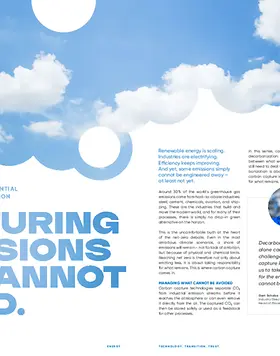
Decarbonization alone cannot solve the challenge – carbon capture is what enables us to take responsibility for the emissions that cannot be avoided.
Gert Schultze

Renewable energy is scaling. Industries are electrifying. Efficiency keeps improving. And yet, some emissions simply cannot be engineered away – at least not yet.
Around 30% of the world's greenhouse gas emissions come from hard-to-abate industries: steel, cement, chemicals, aviation, and shipping. These are the industries that build and move the modern world, and for many of their processes, there is simply no drop-in green alternative on the horizon.
This is the uncomfortable truth at the heart of the net-zero debate. Even in the most ambitious climate scenarios, a share of emissions will remain – not for lack of ambition, but because of physical and chemical limits. Reaching net zero is therefore not only about emitting less. It is about taking responsibility for what remains.
This is where carbon capture comes in.
Carbon capture technologies separate CO₂ from industrial emission streams before it reaches the atmosphere or can even remove it directly from the air. The captured CO₂ can then be stored safely or used as a feedstock for other processes.
In this sense, carbon capture complements decarbonization. It addresses the gap between what we can prevent and what we still need to deal with. Or, put simply: if decarbonization is about reducing what we emit, carbon capture is about taking responsibility for what remains.
As the technology matures, the role of carbon capture is expanding.
Captured CO₂ is increasingly seen not only as something to store, but as something to reuse. This is where concepts such as Power-to-X (P2X) come into play. By combining captured CO₂ with green hydrogen, it becomes possible to produce synthetic fuels such as e-methanol – opening pathways toward low-carbon shipping, aviation, and chemicals.
The same principle is being explored beyond fuels. Captured carbon can be incorporated into products ranging from construction materials and plastics to advanced materials and specialty chemicals, helping reduce dependence on fossil-based raw materials.
This creates a shift in perspective. Carbon is no longer only a cost or a regulatory burden. It becomes a potential raw material that can be reintegrated into industrial cycles.

Gert Schultze
Addressing the diversity of industrial emission sources requires more than a single solution. Decarbonization in practice is complex, and so are the processes behind it. Different industries, gas compositions, and operating conditions call for different technological approaches.
This is where a flexible and scalable portfolio becomes essential.
At ANDRITZ, carbon capture is therefore not defined by one technology, but by a broad and adaptable suite of solutions, each designed to meet specific process requirements while enabling reliable and efficient CO₂ separation.
Amine-based absorption remains one of the most established and widely used technologies. By chemically binding CO₂ in solvent systems, it enables high capture rates and proven reliability across a wide range of industrial applications making it a cornerstone for large-scale deployment.
Hot potassium carbonate processes (HPC) offer a robust alternative, particularly suited for applications with higher CO₂ concentrations. In addition, hot potassium is an inorganic solvent, so it does not decompose and does not release any organic emissions. Especially for industries where steam is not available as energy source HPC has its benefits as it is mainly driven by electric power
At the same time, newer approaches are gaining importance.
Rotating-bed-reactors (RPBs) are attracting increasing attention due to their efficiency in CO₂ capture. They offer specific advantages over conventional fixed-bed columns, particularly in applications with limited space, such as offshore CO₂ capture applications. Systems using RPBs are characterized by a significantly lower height and footprint, made possible by improved absorption efficiency due to finer solvent droplets, which result in a larger surface area for the CO2 mass transfer.
Membrane-based separation technologies provide a compact, simple and energy-efficient pathway for CO₂ capture. It is a physical separation process driven by pressure difference and therefore avoiding the need of any chemical solvent. It opens up additional benefit for industries where footprint and energy consumption are critical factors. Membrane technology requires electricity as an energy source to power the vacuum pump needed to operate the system.
Beyond point-source carbon capture, concepts such as Direct Air Capture (DAC) are exploring ways to remove CO₂ directly from the atmosphere. In this field, ANDRITZ contributes selected separation technologies for carbonate processing.
And crucially, the value chain does not end with capture.
At ANDRITZ, solutions are designed to go one step further, enabling the handling, conditioning, and processing of captured CO₂ for transport, storage, or utilization. In the context of emerging Power-to-X applications, this includes pathways toward e-methanol production, supporting the creation of circular carbon value chains.
In this way, carbon capture becomes more than a technical step. It becomes part of an integrated system linking emission reduction, carbon management, and resource utilization into a single, scalable approach to industrial decarbonization.
Klaus Bärnthaler
The path to net zero is not a straight line. It requires reducing, avoiding, and managing emissions all at the same time.
Because this is not just one challenge among many. Climate change is the defining megatrend of our time, reshaping how we live, how economies function, and how industries operate. According to the United Nations, limiting global warming to 1.5°C requires deep and rapid emission reductions, fundamentally transforming how energy is produced, how materials are manufactured, and how value chains operate. Over the past decade, this has triggered a profound transformation: renewable energy is scaling, industries are electrifying, efficiency is improving, and entirely new technologies are emerging. In that light, decarbonization is becoming an economic, industrial, and societal necessity.
Decarbonization transforms how we produce and use energy. But it cannot eliminate everything. Some emissions will remain, and addressing them is essential. Carbon capture fills this gap, enabling industries to reduce their impact where other solutions reach their limits.
Climate change is not just one challenge among many – it is the megatrend shaping this century. Responding to it requires solutions that work at scale and under real-world conditions.
The technologies are there. The decisive question is whether we use them fast enough, and at scale to meet the challenges ahead.
Take cement – one of the hardest-to-abate industries. Around 60% of its CO₂ does not come from burning fuel at all, but from the chemical reaction that turns limestone into cement. No amount of renewable energy changes that. Capture is the only way to address it.
And the scale is significant. A single commercial cement plant can emit more than one million tonnes of CO₂ annually, equivalent to the emissions of more than 215,000 passenger cars.
Carbon capture technology has the potential to remove these emissions directly from the production process.
And this is no longer theory. The first full-scale cement capture plants are now coming online, proving that these volumes can be captured under real industrial conditions.
CAPTURING CO₂ FROM CEMENT. At a cement plant in Europe, ANDRITZ has been operating a carbon capture pilot plant since 2022, continuously refining the technology to achieve even higher CO₂ purity and efficiency.
FROM PULP MILL TO PILOT PLANT. A European pulp mill is piloting a first-of-its-kind solution to capture biogenic CO₂ directly from mill flue gases with the help of ANDRITZ technology.
CAPTURING CARBON FROM THE AIR. ANDRITZ Technology plays a key role in one of the world's largest Direct Air Capture facilities, helping remove hundreds of thousands of tons of CO₂ from the atmosphere every year.
ANDRITZ is accelerating its activities to deploy with its customers technologies reducing carbon dioxide (CO₂) emissions.


The 1st Shift – Technology. Transition. Trust. We are delighted to introduce you to The Shift, the new magazine from our Environment & Energy business area.


ANDRITZ is accelerating its activities to deploy with its customers technologies reducing carbon dioxide (CO₂) emissions.


The 1st Shift – Technology. Transition. Trust. We are delighted to introduce you to The Shift, the new magazine from our Environment & Energy business area.

Our extensive product portfolio covers a spectrum of technologies ranging from mechanical and thermal solid/liquid separation, grinding, pelletizing, pumping fluids, emission reduction technologies, carbon capture, to green hydrogen and renewable fuel production.
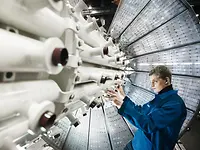
ANDRITZ Separation is the world’s leading separation specialist, with the deepest knowledge, broadest technical resources, and most comprehensive service solutions.
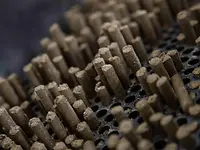
ANDRITZ offers an extensive line of equipment and complete plant solutions for the production of high-quality feed and biomass products.
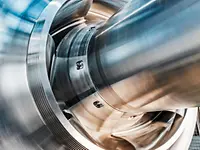
Our engineered pumps are operating in various industrial applications successfully all over the world. They offer robustness and wear resistance and fulfill highest customer expectations in terms of efficiency, life cycle, maintenance friendliness and economic efficiency.
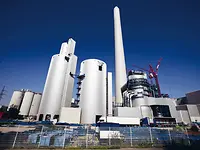
We provide you with tailor-made air pollution control solutions focusing on reduced emissions and improved performance and efficiency to meet changing market conditions and comply with asset strategies. Our offering covers the entire flue gas line, ranging from particulate control, dry and wet scrubbers, to multi-pollutant equipment for industrial, waste-to-energy and power generation plants.
ANDRITZ provides holistic and integrated P2X solutions for producing green hydrogen, e-methanol and e-ammonia.
Welcome to our Tradeshows & Events page! Here you'll find a selection of our key tradeshow participations of this year.