
Annual value € = (Reduced chemical losses + Improved efficiency + Avoided downtime costs) - Cost of services


ANDRITZ OY
Tammasaarenkatu 1
00810 Helsinki
Finland

As temperatures and pressures increase and chemical cycles become more closed, undesired chemicals easily accumulate. Gradually, they affect recovery boiler cleanability, efficiency, availability, and lifetime.
“This is why the attitude toward chloride and potassium removal plants has changed. They are increasingly recognized as a key lever for maintaining production capacity and preventing valuable chemical losses.”

Previously, the chloride and potassium removal plants were left outside systematic maintenance during operations as well as planned shutdowns. According to Saastamoinen, this is changing.
“The higher the steam temperatures and pressures are in the recovery boiler, the greater the emphasis is on chloride and potassium removal plant performance. Maintenance is shifting toward more comprehensive, preventive optimization.”
This shift has a direct and measurable business impact.
Ultimately, the value of chloride and potassium removal plant services is measured in avoided losses and improved performance. There is only one objective in ANDRITZ’s chloride and potassium plant removal services:
“A clear return on investment is delivered by secured boiler availability, cleanability, and maximized lifetime. This is why we run inspections, support operators, and continuously optimize the process.”

The return on investment of systematic chloride and potassium removal services is best explained as a combination of reduced chemical losses, improved energy efficiency, and avoided downtime.
“In practice, these impacts accumulate simultaneously. When the system does not perform as intended, losses appear across all three areas at the same time.”
The financial impact can be millions of euros annually, depending on the mill size and operating conditions. The cost of systematic chloride removal services is usually a fraction of the losses they prevent, resulting in a short and clearly demonstrable payback time.
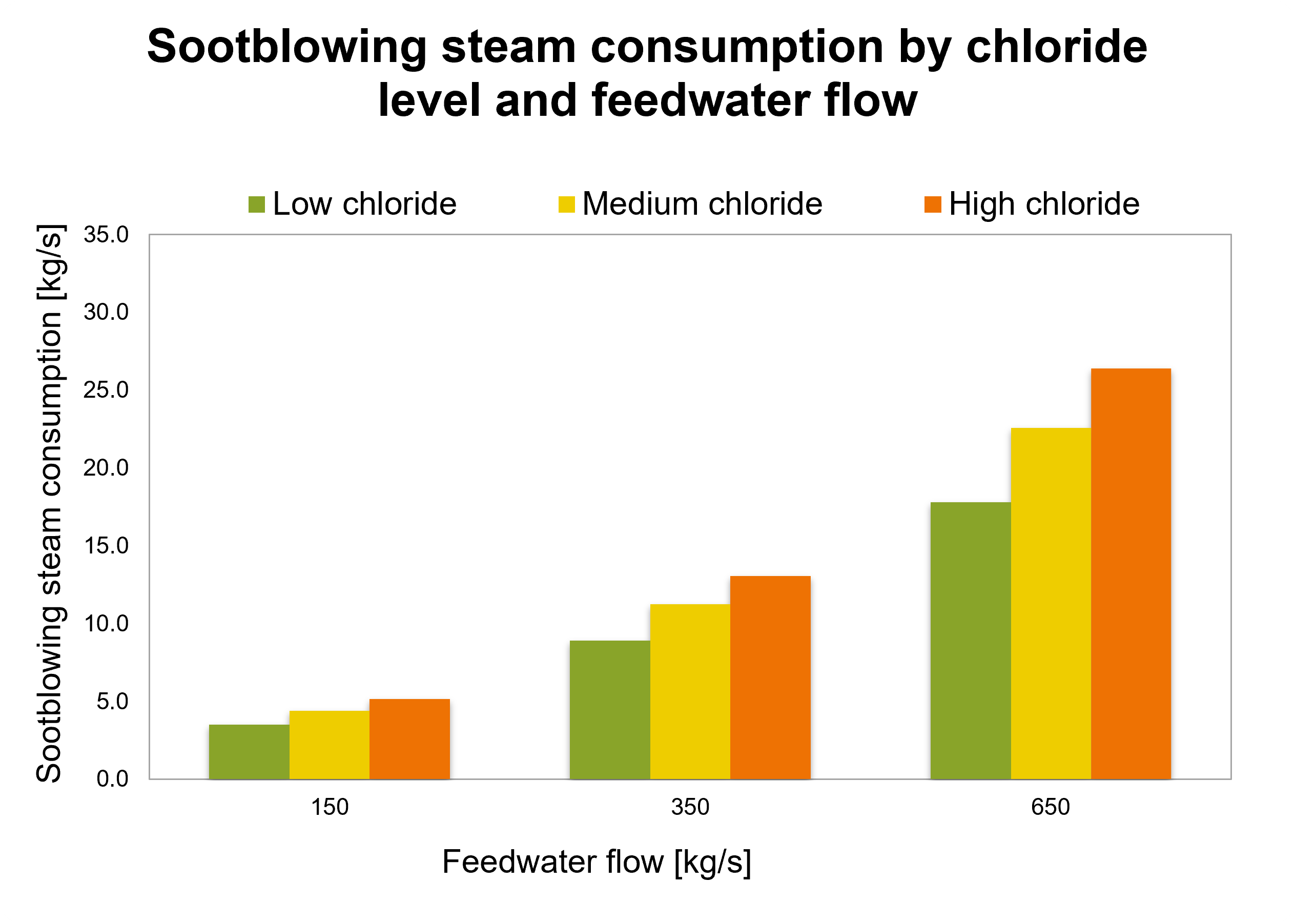
“For example, if a mill loses 40–50% of the sodium contained in electrostatic precipitator (ESP) ash with an underperforming system, compared to 10–15% with a properly maintained one, the difference directly increases chemical costs. At the same time, higher chloride and potassium levels accelerate fouling in the recovery boiler, reduce heat transfer efficiency, and increase sootblowing steam consumption, amplifying the overall loss.”
In more severe cases, elevated chloride and potassium levels can lead to unplanned shutdowns, where the cost becomes immediate and substantial due to lost production.
All these risks can be minimized through systematic services that combine continuous process monitoring, structured mechanical inspections, and operator support that ANDRITZ provides for all types of chloride and potassium removal plants.
Annual value € = (Reduced chemical losses + Improved efficiency + Avoided downtime costs) - Cost of services
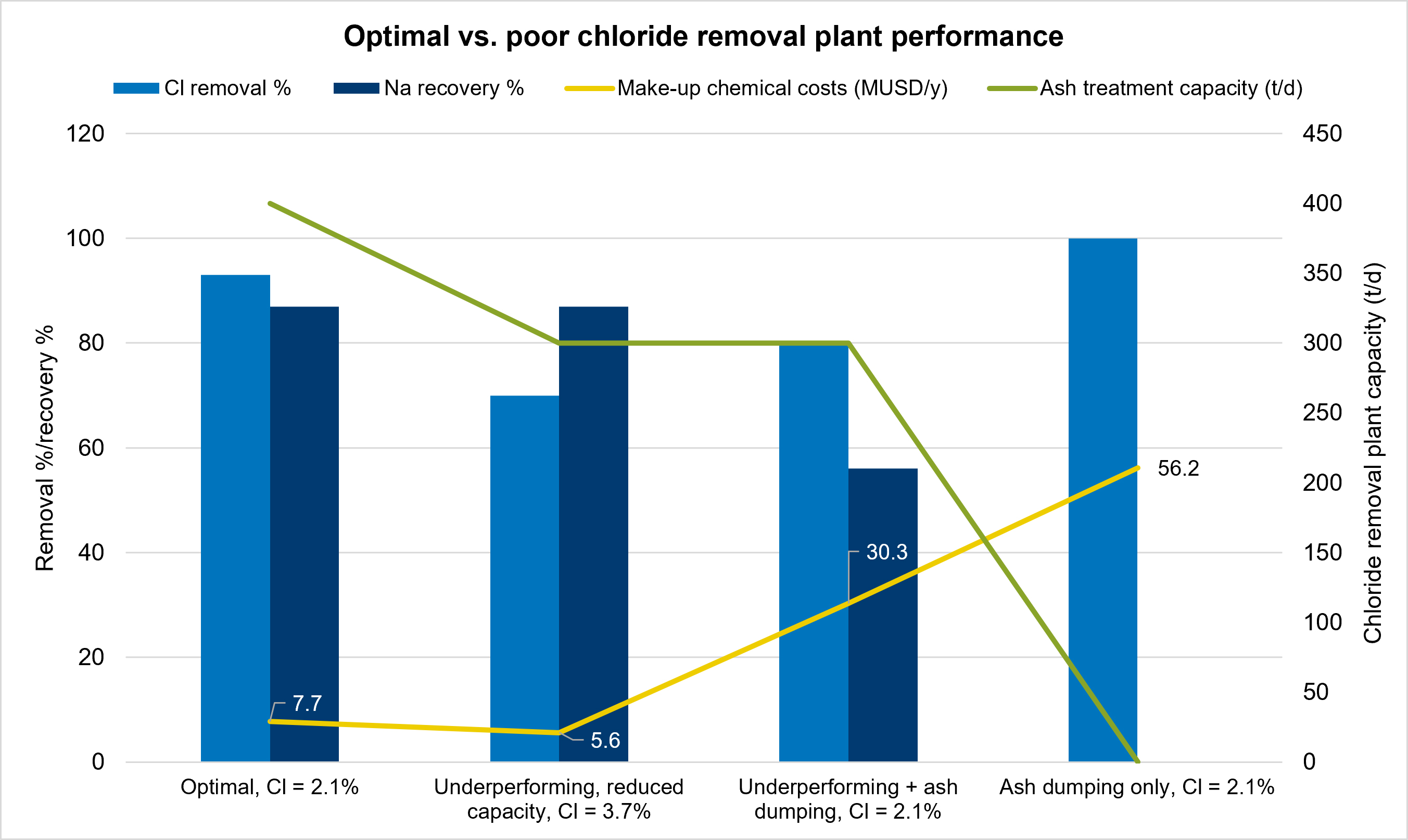
The graphs shown below illustrate a simplified comparison between poorly performing chloride and potassium removal systems and a well-performing, systematically maintained one.
The first graph shows what happens to the Cl removal, Na recovery, and chemical costs when the chloride and potassium removal system operates optimally and when it doesn’t. The second graph shows the sootblowing consumption at low, medium, and high chloride concentrations, linking the chloride and potassium removal plant performance to the steam consumption in the boiler.
The enclosed illustrative graph shows optimal versus poor chloride removal plant performance. It is an example where we examine the impact of poorly working chloride removal plant with design capacity of 400 tons of treated ash per day, and a target chloride content of 2.1% in ESP ash. To reach the target value for Cl content in ESP ash, an underperforming chloride removal plant typically requires simultaneous increase in ash dumping, leading to significant increase in make-up chemical costs.
ANDRITZ offers a full line of systems for chloride and potassium removal from precipitator ash.
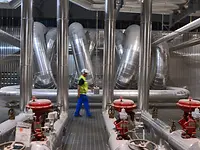
ANDRITZ recovery plant service experts work in close cooperation with you to improve the performance, stability, availability, and efficiency of your recovery boilers and auxiliary equipments.

With over 120 years of experience and a strong global presence, US headquartered Diamond Power brings deep expertise in advanced boiler cleaning technologies and services. These solutions are widely used across the pulp & paper, utility, biomass, waste-to-energy, and industrial sectors.